
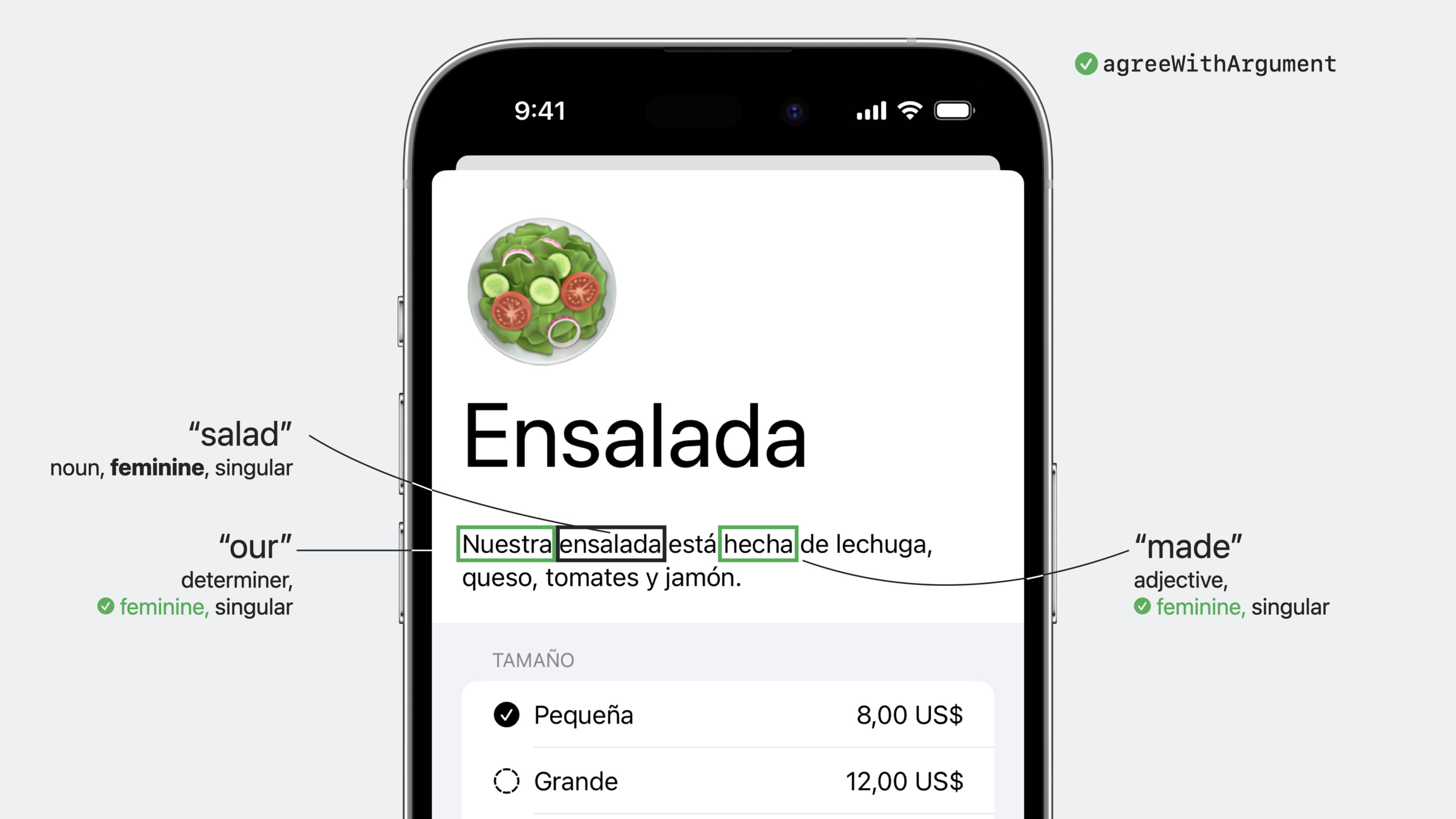
Highlight
Foundation framework adds new dependency agreement API, including
agreeWithConceptandagreeWithArgumentproperties, andTermOfAddresstype andreferentConceptAttributes that allow apps to automatically handle cross-word grammatical consistency and personalized pronoun selection.
Core Content
The value of syntactic consistency
Language in software affects how users interact every day. Processing language is hard, especially when you don’t speak the language.
(00:34) Apple introduced the Grammar Consistency API in Foundation in 2021 to help apps automatically adjust wording based on how users address themselves. This year there are three important upgrades to this system: dependency consistency, inclusive language, and new language support.
Depend on consistency
(01:17) In many languages, adjectives must be consistent in gender and number with nouns. In Spanish “ensalada pequeña” is correct and “ensalada pequeño” is incorrect. The ending of the adjective must change according to the noun.
This kind of grammatical association across words has been difficult to deal with in the past. Two new property solutions were introduced this year:
agreeWithConceptUsed to agree on words outside the string. For example, the description of food size needs to be consistent with the name of the food:
var options = AttributedString.LocalizationOptions()
options.concepts = [.localizedPhrase(food.localizedName)]

let size = AttributedString(localized: "small", options: options)
Key points:
conceptsPass in an object that affects syntax changes but does not directly insert strings -.localizedPhrasePackaging requires agreed phrases- in string
^[small](agreeWithConcept: 1)The annotation indicates that the word should be consistent with the first concept
agreeWithArgumentUsed to agree on words within the same string:
"^[Our](inflect: true) ^[pizza](arg1) is ^[made](agreeWithArgument: 1) fresh"Key points:
inflect: trueMake the words in the block agree with each other -agreeWithArgument: 1Make the word consistent with the first parameter in the string- try to keep
inflectKeep blocks short and reduce ambiguity
Inclusive language
(08:12)TermOfAddressThe type supports three calling methods: masculine, feminine, and neutral. CooperatereferentConceptattribute, the system automatically selects the correct pronoun.
struct DeliveryPerson {
    var name: String
    var avatar: Image
    var preferredTermsOfAddress: [TermOfAddress]
}

var options = AttributedString.LocalizationOptions()
options.concepts = [.termsOfAddress(person.preferredTermsOfAddress)]

let message = AttributedString(
    localized: "\(person.name) is on ^[their](referentConcept: 1) way.",
    options: options
)
Key points:
TermOfAddresscan be.masculine、.feminine、.neutralreferentConcept: 1Indicates that the pronoun refers to the first concept- The system is based on
TermOfAddressAutomatically replace with correct pronoun form - Also supports custom pronouns, use
Morphology.PronounSpecify specific form
Added language support
(02:29) Spanish support in 2021. French, Italian and Brazilian Portuguese coming in 2022. New this year are European Portuguese and German.
Detailed Content
Grammar annotations in String Catalog
(11:40) In Xcode’s String Catalog, you can directly add syntax attributes to localized strings:
// Spanish: make "nuestro" agree with "pizza"
"^[Our](inflect: true) ^[pizza](arg1)"

// Make "made" agree with the first argument, "pizza"
"^[made](agreeWithArgument: 1) fresh"
Key points:
- Add properties directly in the String Catalog editor
-
inflect: trueApplies to words within the same block -agreeWithArgumentSuitable for distant words - value
1Indicates the same as the first parameter
Food Size Consistency
(12:48) Food size needs to vary according to specific food name:
// Define food sizes with localized names
enum FoodSize: String {
    case small, medium, large

    func localizedName(for food: Food) -> String {
        // Return a size name that agrees with the food gender
    }
}

// Format the size buttons
var options = AttributedString.LocalizationOptions()
options.concepts = [.localizedPhrase(food.localizedName)]

let sizeButton = AttributedString(
    localized: "\(size.localizedName(for: food))",
    options: options
)
Key points:
localizedPhrasePass in the food name as concept- size name passed
agreeWithConceptAgree on food names - In Spanish, pizza (feminine) corresponds to “pequeña” and sandwich (masculine) corresponds to “pequeño”
Custom pronouns
(10:19) If the default masculine/feminine/neutral is not enough, you can useLocalizedTermOfAddressSpecify specific pronouns:
let customPronouns = LocalizedTermOfAddress(
    language: "en",
    pronouns: [
        Morphology.Pronoun(
            pronoun: "they",
            morphology: Morphology(grammaticalCase: .nominative)
        ),
        Morphology.Pronoun(
            pronoun: "them",
            morphology: Morphology(grammaticalCase: .accusative)
        ),
        // ... other cases
    ]
)
Key points:
- Specify target language
- List all required pronoun forms
- Each pronoun contains morphological and grammatical case information
- English requires 5 pronoun forms
Core Takeaways
-
Add syntax consistency to multi-language applications
- If the app supports Spanish, French, German, etc., use
inflect: trueandagreeWithArgumentAutomatically handles adjective and noun agreement - No need to write special logic for each language
- Entry: Add attribute annotation in String Catalog
- If the app supports Spanish, French, German, etc., use
-
Implement personalized pronoun support
- Add to user profile
preferredTermsOfAddressField - use
TermOfAddressandreferentConceptAutomatically select the correct pronoun - Entrance:
TermOfAddress.masculine/.feminine/.neutral
- Add to user profile
-
Fix syntax errors in existing localizations
- Check whether adjectives and nouns in localized strings such as Spanish and French are consistent
- use
agreeWithConceptHandling inflections across strings - Entry: in String Catalog
agreeWithConceptandagreeWithArgumentproperty
Related Sessions
- What’s new in Foundation — New features of the Foundation framework
- Build accessible apps with SwiftUI and UIKit — Build accessible apps with SwiftUI and UIKit
- Localize your SwiftUI app — SwiftUI app localization guide
- What’s new in SwiftUI — SwiftUI 2023 new features
Comments
GitHub Issues · utterances