
Protect mutable state with Swift Actor
Highlight
Actor automatically isolates the mutable state of the class in the serial execution domain, and external access must pass
await. The compiler will force check this rule - forgetawaitThe code fails to compile directly. A counter that originally needs to be locked manually can be used by actorclassChange toactor, thread safety is guaranteed by the language and runtime.
Core Content
Data race is one of the most hidden bugs in concurrent programming: two threads read and write the same variable memory at the same time, the results are unpredictable, difficult to reproduce, and debugging is even more of a nightmare. The traditional solution is to use a lock (NSLock) or a serial dispatch queue (DispatchQueue) to protect the shared state, but it is easy to miss, difficult to test, and has the risk of deadlock.
The actor type introduced in Swift 5.5 solves this problem at the language level. Actor is a special reference type whose mutable state is isolated inside the actor. When external code accesses an actor’s properties or methods, it must passawaitExplicitly mark this as a potential hanging point. The compiler enforces checking of this rule, turning the data race from a runtime error to a compile-time error.
Detailed Content
Data competition problem
A simple counter, usingclassImplementation with data race (00:42):
class Counter {
    var value = 0
    func increment() -> Int {
        value = value + 1
        return value
    }
}

let counter = Counter()

Task.detached {
    print(counter.increment()) // data race!
}
Task.detached {
    print(counter.increment()) // data race!
}twoTaskcall simultaneouslyincrement,value = value + 1It is not an atomic operation and the results are unpredictable.
Limitations of value types
Value types (struct) naturally have no data competition, because every assignment is a copy (02:20):
var array1 = [1, 2]
var array2 = array1
array1.append(3)
array2.append(4)
print(array1) // [1, 2, 3]
print(array2) // [1, 2, 4]
But value types cannot express shared mutable state. Change Counter to struct (02:59). Each Task gets an independent copy, and the result is always 1:
struct Counter {
    var value = 0
    mutating func increment() -> Int {
        value = value + 1
        return value
    }
}

Task.detached {
    var counter = counter
    print(counter.increment()) // always prints 1
}
Actor isolation
WillclassChange toactor(05:23), the compiler automatically guarantees serial access:
actor Counter {
    var value = 0
    func increment() -> Int {
        value = value + 1
        return value
    }
}

let counter = Counter()

Task.detached {
    print(await counter.increment())
}
Task.detached {
    print(await counter.increment())
}
Method calls inside an Actor are synchronous (07:51).resetSlowlyCalled multiple times inside a methodincrement,unnecessaryawait:
extension Counter {
    func resetSlowly(to newValue: Int) {
        value = 0
        for _ in 0..<newValue {
            increment()  // Synchronous call, no await needed
        }
        assert(value == newValue)
    }
}
State assumptions after suspension
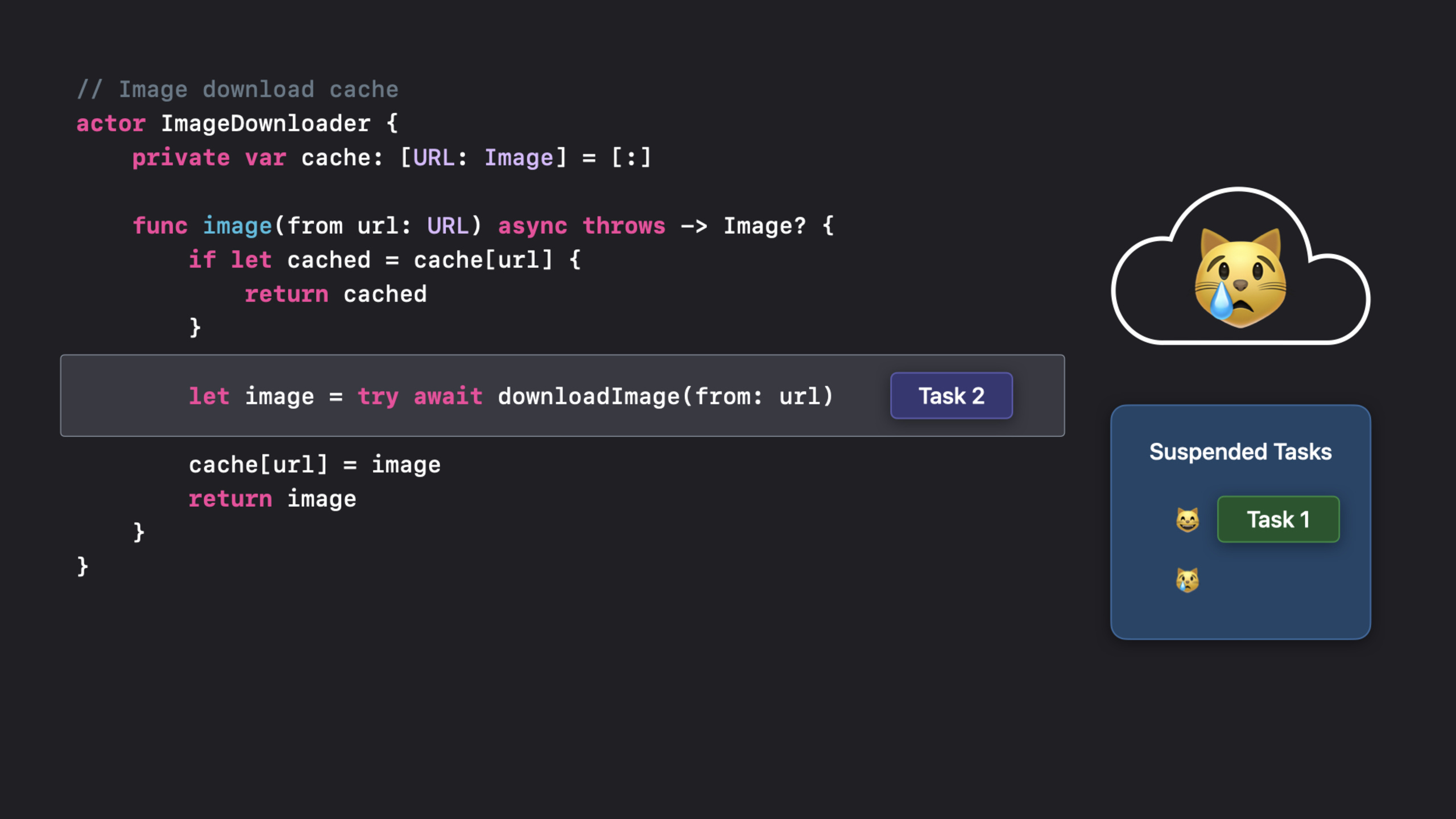
awaitWill suspend the current execution, during which the actor state may be modified by other tasks. ImageDownloader’s caching logic has a classic bug (09:02):
actor ImageDownloader {
    private var cache: [URL: Image] = [:]

    func image(from url: URL) async throws -> Image? {
        if let cached = cache[url] {
            return cached
        }
        let image = try await downloadImage(from: url)
        // Bug: the cache may have been modified by another task during await
        cache[url] = image
        return image
    }
}
await downloadImageDuring this time, another task may have completed downloading the same URL and written it to the cache. Solution (11:59): UseinProgressStatus to prevent repeated downloads:
actor ImageDownloader {
    private enum CacheEntry {
        case inProgress(Task<Image, Error>)
        case ready(Image)
    }
    private var cache: [URL: CacheEntry] = [:]

    func image(from url: URL) async throws -> Image? {
        if let cached = cache[url] {
            switch cached {
            case .ready(let image):
                return image
            case .inProgress(let task):
                return try await task.value  // Wait for the existing task to complete
            }
        }

        let task = Task { try await downloadImage(from: url) }
        cache[url] = .inProgress(task)

        do {
            let image = try await task.value
            cache[url] = .ready(image)
            return image
        } catch {
            cache[url] = nil
            throw error
        }
    }
}
Protocol compliance and actor isolation
Static methods are naturally executed outside the actor (13:30):
actor LibraryAccount {
    let idNumber: Int
    var booksOnLoan: [Book] = []
}

extension LibraryAccount: Equatable {
    static func ==(lhs: LibraryAccount, rhs: LibraryAccount) -> Bool {
        lhs.idNumber == rhs.idNumber  // Static method, no await needed
    }
}
Instance methods can be usednonisolatedMarked for execution outside the actor (14:15), but only accessibleletconstant:
extension LibraryAccount: Hashable {
    nonisolated func hash(into hasher: inout Hasher) {
        hasher.combine(idNumber)  // idNumber is let, so it is safe
    }
}
Passing data across Actors
When passing data between actors, value types (structs) are safe because copies are passed (17:15):
struct Book {
    var title: String
    var authors: [Author]
}

func visit(_ account: LibraryAccount) async {
    guard var book = await account.selectRandomBook() else { return }
    book.title = "\(book.title)!!!"  // OK: modifying a local copy
}
Reference types (classes) are risky (17:39). For class instances taken out from actors, external modifications will affect the internal state of the actor:
class Book {
    var title: String
}

func visit(_ account: LibraryAccount) async {
    guard var book = await account.selectRandomBook() else { return }
    book.title = "\(book.title)!!!"  // Not OK: modifying a shared reference
}
Sendable protocol
SendableTypes of protocol markers that can be passed safely across concurrent domains (20:08). struct automatically satisfies Sendable (if all properties are satisfied):
struct Book: Sendable {
    var title: String
    var authors: [Author]
}
Generic types can be followed with conditions (20:43):
struct Pair<T, U> {
    var first: T
    var second: U
}

extension Pair: Sendable where T: Sendable, U: Sendable { }
Main Actor
UIKit requires all UI operations to be performed on the main thread. The traditional approach is to useDispatchQueue.main.async(24:19):
func checkedOut(_ booksOnLoan: [Book]) {
    booksView.checkedOutBooks = booksOnLoan
}
DispatchQueue.main.async {
    checkedOut(booksOnLoan)
}@MainActorLet the compiler guarantee that functions are always executed on the main line (25:01):
@MainActor func checkedOut(_ booksOnLoan: [Book]) {
    booksView.checkedOutBooks = booksOnLoan
}

await checkedOut(booksOnLoan)  // Swift ensures execution on the main thread
Classes can also be marked as@MainActor(26:21), all its methods are implicitly executed on the main thread:
@MainActor class MyViewController: UIViewController {
    func onPress(...) { ... }  // Implicit @MainActor

    nonisolated func fetchLatestAndDisplay() async { ... }  // Explicitly leaves the main thread
}
Core Takeaways
-
Replace manual locks with actors: New projects can be directly replaced with actors.
NSLockand Serial DispatchQueue. When migrating old projects, first change the outermost state management object to actor. -
Be alert
awaitSubsequent state changes: In the actor method,awaitWhen re-executing after suspending, the actor state may have been modified. don’t assumeawaitThe previous judgment still holds. -
use
inProgressPattern to prevent duplication of work: For time-consuming operations (such as network downloads), mark “in progress” with an enumeration status to let subsequent requests wait for the same task to complete instead of initiating repeated requests. -
Prefer using value types to transfer data across actors: The copy semantics of struct are naturally safe. If you must use a class, make sure it is implemented
SendableOr will not be modified outside the actor. -
Use
@MainActorsubstituteDispatchQueue.main.async:@MainActorThread safety is ensured at compile time and is more reliable than the dispatch queue at runtime. UI-related types such as ViewController and ViewModel can be directly marked as@MainActor。
Related Sessions
- WWDC2021 10132 - async/await in Swift — async/await basics, the prerequisite for understanding actors
- WWDC2021 10134 - Exploring Swift Structured Concurrency — The use of Task, TaskGroup and actors
- WWDC2021 10019 - Concurrency in SwiftUI —
@MainActorPractice in SwiftUI - WWDC2021 10216 - ARC in Swift — The underlying mechanism of reference types and concurrency safety
Comments
GitHub Issues · utterances